Rebel Mouse

Rebel Mouse

Showing posts with label Caregiving. Show all posts

Tuesday, July 7, 2015

Safe 60 And Safe Behind The Wheel: A Conversation With Your Parents

Safe 60 And Safe Behind The Wheel: A Conversation With Your Parents


Did you back into something?

Is everything okay?

How about if I drive?

These are some of the common phrases adult children think and sometimes utter to their aging parents.

What if someone else started the conversation? A third-party began a dialogue about the health and safety of aging drivers in the United States.  

My name is Judi Bonilla a gerontologist researching senior transportation and identifying gaps in services. The 60 Plus and Safe Behind The Wheel presentation is the first of its kind in the nation that both educates participants on resources to improve their driving skills and all transportation options available as they actively decrease their driving on their own terms.

Researchers tell us many older adults self-regulate their driving. You might recognize the reduction of driving in these patterns.

  1. Decreasing or eliminating driving after dark.
  2. Avoiding freeways.
  3. Reducing the time spent driving. 

Many of the students in my workshops are active, healthy, and living independently. They openly express their concern about their ability to continue driving.  It's my goal to start the dialogue what it means to be an aging driver. It's my hope that you'll keep the momentum going by continuing the conversation with your family members.

If you're interested in learning more about my workshops or tips on starting the conversation please contact me at judibonilla.com


Judi Bonilla aging expert, gerontologist, and serial entrepreneur. For more ideas on aging well sign up for her FREE newsletter at judibonilla.com.


Friday, January 3, 2014

Make 2014 The Year of the Caregiver

Judi Bonilla Tips for Managing Stress
“Put the oxygen mask on first,” is the call we hear from the flight attendants every time a pilot prepares for take off. You have to take care of yourself, before you can take care of others.  Before I tell you how I want you to know I also hear


It’s different for me because
I hear a chorus of voices as if we were gathered around my kitchen table. 
  • “I know I should.”
  • “I don’t have the time.” 
  • “There’s no one to help.” 
The fact are if you are a caregiver your health is at risk and now is the time to take charge of your well being.  In a study by the National Alliance for Caregiving, 53% of caregivers  said their health had gotten worse due to caregiving.  Another study found elderly people who felt stressed while taking care of their disabled spouses were 63% more likely to die within 4 years than caregivers who were not feeling stressed.
Clearly now is the time to begin the practice of self-care and the first step is to manage your stress
2014 Caregivers Action Plan To Manage Stress
  1. Banish the words should, would, and could from your internal thoughts and your conversation. For many, these words are often connected with feelings of guilt, self recrimination, and blame.  Research shows, what you say to yourself affects your attitudes, habits, and health. The next time the words should, would, and could form in your thoughts...Take a deep breath in and ask yourself  “What do I really want say?” “What am I really feeling?” As you exhale take advice from the Poet Maya Angelou, “You did what you knew how to do, and when you knew better, you did better."
  2. Practice better mental and physical health habits. I use the word practice to encourage you to look at each habit as a way to learn and improve self-care habits to handle life’s events and prepare for the future. The easiest and most inexpensive practice is to begin walking. Walk with a mindful attitude and focus your thoughts on your breathing. No talking, no planning, no replaying of a past conversation. Walk and focus on your breathing. Simply keep your thoughts on breathing in and out. Start your mindful walking practice with five minutes once a day. Increase the time of your walk slowly with the knowledge your practice is building the foundation for self-care.
  3. Begin Again know that none of us were born with all the answers, skills, and wisdom needed to live a happy and healthy life. Each of us learns through experience and the wise learn from the experience of others. Self-care is the art of treating ourselves with the same kindness, love, and understanding we give those we care for.
2014 The Year of the Caregiver is my hope for you as we start the New Year together.
Judi Bonilla is a Gerontologist and ED of We Get Around! a nonprofit organization working to promote the use of public transportation for adults approaching driving retirement. 
Follow Judi Bonilla on Twitter: @JudiBonilla


Friday, December 27, 2013

Why Your Family Needs To Talk About Caregiving Today

Latino Family
Keeping Your Family connected
On Friday, November 1st, National Family Caregivers Month officially begins. If you’ve ever been a caregiver you know the emotional, mental, and physical health problems that accompany caring for a loved one.
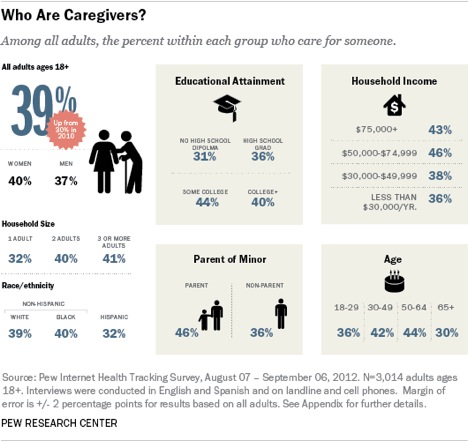
As our population ages the need for caregivers has increased and many of us our stepping into caregiving roles. This year the Pew Research Center reported:
  • 39% of U.S. adults are caring for a loved one with significant health issues.
  • 36% of U.S. adults said they provided unpaid care to an adult relative or friend in the past year.
  • 32% of U.S. caregivers are Hispanic.
So, what does caregiving mean to you?
Be prepared. The facts are in your lifetime. “You’ve either been a caregiver. You’re going to be a caregiver. You’re going to need a caregiver.” Remember “It’s not if, It’s When.”
From the Caregiver Action Network, “Maybe it started slowly. You visited your parents and started to worry about them living alone. You found yourself taking over more of the responsibilities for your spouse. Maybe it happened all of a sudden. Mom slipped and broke her hip. The neighbors called to say that dad was wandering around looking lost. However it began, you are now a family caregiver. ”
Caregiving is a role we often assume when a loved one needs assistance, care or help managing everyday tasks. We step in the role untrained and with no experience. All families will be involved with caregiving at some time.
Untitled1
Before the inevitable happens begin the conversation now. Ask now what role each of you will play. Who will make phone calls? Who will run errands? Who will manage medical paperwork? Who will provide hands on caregiving?
Every morning we make choices on the outcomes we want. Go to work, to provide a service and earn a salary. Put on a seatbelt, to avoid injury. Connect with a friend, to get and provide support.
Caregiving is similar — we want the best for our familias, to love and be loved.
Read more about CaregiverMonth and follow #NowMoreThanEver hashtag to join in the conversation.
Judi Bonilla is an aging expert, educator and social entrepreneur.