Rebel Mouse

Rebel Mouse

Showing posts with label Older Adults. Show all posts

Sunday, July 5, 2015

Is Facebook The Best Way To Exercise Your Brain?


Facebook? Lumosity? Brain HQ?


University of Arizona: Facebook Article
There are plenty of choices when it comes to giving your brain a workout. My choice will always be Facebook especially for adults age 65+! Yes, I believe that Facebook meets and exceeds the requirements for giving your brain robust workout.

Ask neuroscientists and experts in memory training they often list three requirements to provide real cognitive benefits.

  1. Novel
  2. Variety
  3. Complex

Novel

Login to Facebook and you often surround yourself with changes in features. Most recently Facebook is focusing on uploading native videos, before that it was changes in messaging. If novel is what you are looking for Facebook will continue to meet that requirement.

Variety

Everyday pages and new groups are added, videos go viral and information is shared. Users have the ability to find friends, information, and resources all within a few clicks.

Complex

If you're age 65 and over your use of technology may be limited. Using Facebook requires using fine motor skills, hand-eye coordination and ultimately focus. While digital natives may find Facebook intuitive for many older users the layout and using tools requires concentration.

Lastly, Facebook is a connector! Connecting grandparents family members, individuals to their interests, and all the while decreasing social isolation. I believe the real power behind Facebook is allowing its user to reconnect and nurture friendships.

Judi Bonilla is a San Diego gerontologist focusing on researching, developing, and teaching healthy aging programs. She’s the founder of We Get Around! focused on senior transportation, Brain Fit Now! a community-based brain health program. Encorepreneur 101 boosting entrepreneurs age 50 plus. Connect with Judi on Facebook to stay find out the latest news in healthy aging.


Friday, December 27, 2013

Why Your Family Needs To Talk About Caregiving Today

Latino Family
Keeping Your Family connected
On Friday, November 1st, National Family Caregivers Month officially begins. If you’ve ever been a caregiver you know the emotional, mental, and physical health problems that accompany caring for a loved one.
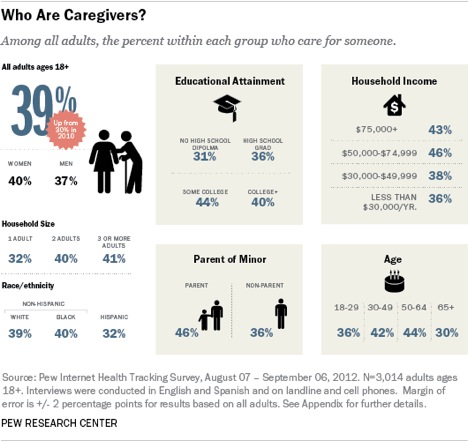
As our population ages the need for caregivers has increased and many of us our stepping into caregiving roles. This year the Pew Research Center reported:
  • 39% of U.S. adults are caring for a loved one with significant health issues.
  • 36% of U.S. adults said they provided unpaid care to an adult relative or friend in the past year.
  • 32% of U.S. caregivers are Hispanic.
So, what does caregiving mean to you?
Be prepared. The facts are in your lifetime. “You’ve either been a caregiver. You’re going to be a caregiver. You’re going to need a caregiver.” Remember “It’s not if, It’s When.”
From the Caregiver Action Network, “Maybe it started slowly. You visited your parents and started to worry about them living alone. You found yourself taking over more of the responsibilities for your spouse. Maybe it happened all of a sudden. Mom slipped and broke her hip. The neighbors called to say that dad was wandering around looking lost. However it began, you are now a family caregiver. ”
Caregiving is a role we often assume when a loved one needs assistance, care or help managing everyday tasks. We step in the role untrained and with no experience. All families will be involved with caregiving at some time.
Untitled1
Before the inevitable happens begin the conversation now. Ask now what role each of you will play. Who will make phone calls? Who will run errands? Who will manage medical paperwork? Who will provide hands on caregiving?
Every morning we make choices on the outcomes we want. Go to work, to provide a service and earn a salary. Put on a seatbelt, to avoid injury. Connect with a friend, to get and provide support.
Caregiving is similar — we want the best for our familias, to love and be loved.
Read more about CaregiverMonth and follow #NowMoreThanEver hashtag to join in the conversation.
Judi Bonilla is an aging expert, educator and social entrepreneur.

Wednesday, July 31, 2013

Why Public Transportation Can Save Your Retirement

New Public Transit Riders
Retirees enjoying their
first ride on public transit!

Driving retirement is inevitable. Research shows men outlive their ability to drive by six years and for women it's about 10 years.

What happens when you no longer driver? Who do you ask for a ride? Neighbors? Children? Grandchildren? Friends? The answer is yes. You begin to prepare for your transportation while you continue to drive.

However, like most American's you want your independence and want to remain self reliant. Riding public transportation is an excellent way to control your schedule. However, for many adults over 65 years of age it's been a long time since you've ridden the public. Here are a few ideas to get you out in your community on public transportation.

Training
Do your homework. Contact your local transportation provider to find out if they offer "Travel Instruction" or "Travel Training" classes. These classes are often available to older adults who are transitioning out of driving. Led by a trained Travel Instructor you'll learn how to plan and travel using your communities public transportation systems.


We Get Around! Transportation Instruction Judi Bonilla
Plan your driving retirement and
learn how to use public transportation.

Education

If classes are unavailable in your community, GoogleMaps is now your best friend. For novices I suggest planning a trip to a local mall or another familiar location. In GoogleMaps you can plan and get detailed directions to your destination


Safety
Before you leave home pack light. That means removing extra money, credit cards, and jewelry. As a novice transit ride everything you experience will be new. Keep your focus on personal safety and not how heavy your bag is! I also suggest carrying a coin purse and use this to keep your exact fare and ticket.  


Travel
With age comes wisdom and also rights to priority seating. After paying your fare use the seating closest to the driver for your journey. Once you become a regular transit rider carrying a book is always an excellent way to avoid an unwanted conversation.

The important point is to get out and explore your community using public transportation. Using public transportation is a great way to maintain an active lifestyle as you age.